Monday, 28 October 2013

PROGRAM/AKTIVITI KELAB GEOLOGI SEPANJANG TAHUN 2013


1.             AAPG Visiting Geoscientist Programme (VGP) : 17 Mac 2013
2.             Petroleum Geoscience Conference & Exhibition 2013 (PGCE) : 18-19 Mac
3.             lawatan UMS ke UKM : 16-20 Mac 2013
4.             Ekspedisi Gunung Senyum & Gunung Jebak Puyuh : 5-7 April 2013
5.             Family Day Geologi 2013 : 10 Mei 2013
6.             Dinner Geology 2013 : 11 Mei 2013
7.             National Geoscience Conference (NGC) : 25-26 Mei 2013
8.             Suka Suki Geologi (Interaction day) : 12 Sept 2013
9.             Jamuan Tautan kasih 2013 : 13 Sept 2013
10.         8th MALAYSIA GEOHERITAGE CONFERENCE : Sept 2013
11.         Pameran Geologi sempena Pesta Konvo : 17-19 Okt 2013
12.         Majlis Konvokesyen Graduan Geologi : 29 okt 2013 
13.         Technical Programme : H.D Tjia : 30 Okt 2013
14.         Career Talk Univ. Malaya : Role of Geoscience in O&G Industry : 13 Nov 
15.         Oil & Gas Festival 2013 : UTM Skudai : 20-22 Nov 2013


Sunday, 20 October 2013

8th MALAYSIA GEOHERITAGE CONFERENCE
6th INDONESIA –MALAYSIA JOINT GEOHERITAGE CONFERENCE


Persidangan ini dianjurkan oleh LESTARI UKM, Kumpulan Warisan Geologi, Jabatan Mineral dan Geosains Malaysia dan Universitas Pembangunan Nasional ‘Vateran’ dengan kerjasama Jabatan Warisan Negara dan juga Kerajaan Negeri Pahang Darul Makmur. Pada persidangan kali ini, ahli-ahli geologi daripada Malaysia dan Indonesia berusaha untuk mengetengahkan tapak-tapak warisan geologi penting yang dimiliki oleh Negara masing-masing dan berusaha untuk membangunkan tapak-tapak ini secara lestari. Pembangunan lestari dalam konteks ini melihat pembangunan yang mengambilkira pemuliharaan sumber tabii, pengenalan sumber sebagai tarikan pelancong khususnya sebagai geo dan ekopelancongan disamping memperkasakan ekonomi komuniti setempat dan membangunkan infrastruktur kawasan luar Bandar. Dengan itu amat bertepatan dengan tema persidangan pada kali ini iaitu “Geoheritage for Sustainable Regional Development” atau “Geowarisan untuk Pembangunan Lestari Wilayah”. 


Dalam konsep pembangunan lestari, penekanan diberikan kepada keseimbangan antara memenuhi keperluan manusia dengan keupayaan system semula jadi untuk membekalkan produk dan perkhidmatan tanpa degradasi. Salah satu kejayaan besar memartabat sumber warisan geologi mengikut acuan pembangunan lestari wilayah ialah dengan perwujudan Langkawi Geopark di Malaysia dan Batur Geopark di Pulau Bali, Indonesia. Dalam persidangan ini juga dialog berkenaan pemuliharaan warisan geologi khusus untuk negeri Pahang dan mudah-mudahan negeri Pahang yang sememangnya kaya dengan sumber geologi akan mempunyai satu Geopark tersendiri.


Nukilan : Kamilia Sharir 

Thursday, 10 October 2013

A WORLD OF ROCK

We live on the surface of giant ball of rock, the Earth. The oldest rocks discovered so far on our planet are in northwestern Canada. They are about 4 billion years old. Other rocks are much more recent, and new rocks are forming all the time.


Rocks develop in different ways from hot,melted rock, from the fossil remains of animals and plants that solidify into rock over millions of years, and by the action of heat and pressure on ancient rocks inside the earth.

no rocks, however tough, last forever. They are worn away over time by water, wind and other powerful force of erosion. The earth's rocks are full of extremely valuable burried tressure. They give us preciuos stones, precious metals and vital resources such as iron and coal.


Source : Rocks and fossils [Margaret Hynes]

Sunday, 29 September 2013

Oil shales

A high proportion of organic material in mudrocks can be driven off as a liquid or gas by heating. These are called oil shales. The organic materials usually comes from dead algae that have broken down to form kerogen during diagenesis. Kerogen is a long chain hydrocarbon that form petroleum when they are heated.

The environments in which they formed must be anaerobic (lacks of oxygen) to prevent oxidisation of the organic material. This condition can only be found in lakes and shallow marine environment. Oil shales are black and the presence of hydrocarbons may be detected by the smell of the rock. It will make a brown, oily stain on other materials.

Largest oil shale reserves


Sources:   Gary Nichols. Sedimentology and Stratigraphy Second Edition

Monday, 23 September 2013

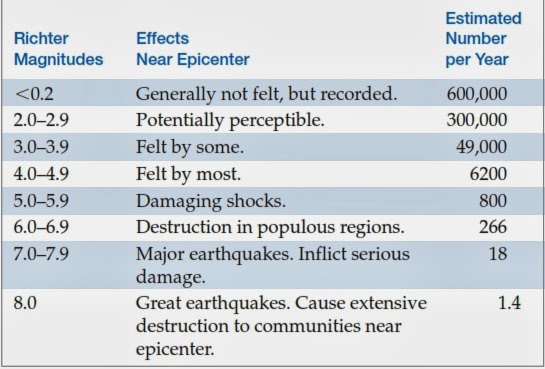
Earthquake Magnitude and Expected World Incidence

Earthquake vary enormously in strength. And to measure these wide variations, geologists used a logarithmic scale to express magnitude, which is called as Richter scale where a tenfold increase in wave amplitude corresponds to an increase of 1 on the magnitude scale. Thus, the amount of ground shaking for a 5-magnitude earthquake is 10 times greater than that produced by an earthquake having a Richter magnitude of 4.

Expected World Incidence


A major earthquake with a magnitude of 8.5 releases millions of times more energy than the smallest earthquakes felt by humans. The December 26, 2004 Indian Ocean tsunami was caused by an earthquake that is thought to have had the energy of 23,000 Hiroshima-type atomic bomb. The epicenter of the 9.0 magnitude quake was under the Indian Ocean near coastal areas of Aceh. Over 170,000 people were killed by tsunami in Aceh alone.

                         Sources: Edward J. Tarbuck. Earth: An Introduction to Physical Geology
                                       http://en.wikipedia.org/wiki/Aceh#Tsunami_disaster
                                     

Wednesday, 18 September 2013

NATIONAL UNIVERSITY OF MALAYSIA
~ GEOLOGY PROGRAMME 2013 ~

The geology programme of Universiti Kebangsaan Malaysia is commited to becoming a leading Earth Science institute in Malaysia. The Geology programme intends to produce graduate with an understanding of earth science, critical thinking ability, the attitude as well as skill to conduct research and the ability to apply it in the working environment.

1st year

2nd year

3rd year


Time passes, memories fade, feeling change, people leave but... 
Hearts never forget

Alumni 2010/2013

Sunday, 15 September 2013

PROGRAM SEMESTER BARU 2013

SUKA SUKI GEOLOGI 2013
12 SEPTEMBER

Program Suka Suki Geologi ini diadakan bertujuan khas untuk menyambut kehadiran pelajar baru Geologi tahun satu dan berobjektif untuk merapatkan lagi hubungan silaturahim antara semua mahasiswa geologi tahun 1,2 dan 3. Aktiviti yang diadakan adalah berbentuk "Explorace" di sekitar bangunan Geologi dan para pelajar dibahagikan kepada beberapa kumpulan untuk memupuk perkenalan dan semangat berpasukan. Pengisian program ini sememangnya mengunakan aspek-aspek pengenalan kepada geologi dan mengaplikasikan pengetahuan-pengetahuan geologi yang berguna untuk melatih diri menjadi ahli geologi yang sejati dan berkualiti. Jadi disamping bersuka suki, kami juga dapat belajar kemahiran dan ilmu geologi dengan lebih lagi. 


Pendaftaran Pelajar


Pembahagian kepada Kumpulan

Ice Breaking

3rd year menjaga check point

Taklimat Aktiviti
 #1st year
#2nd year
#3rd Year
Penampilan istmewa En Hariri & abg2 master


KUMPULAN-KUMPULAN 


Presiden Kelab Geologi  


JAMUAN TAUTAN KASIH
13 SEPTEMBER 2013

Jamuan ini diadakan bertujuan sebagai Majlis Pembukaan Semester baru 2013. Seperti kebiasaan & kewajipan kami daripada pihak program menjemput Anak-anak Yatim Darul Ruqyah sebagai penyeri majlis. Majlis turut dihadiri oleh para pensyarah dan semua warga geologi. Diharap dengan semangat baru para pelajar dan iringan doa oleh kita semua dapat menjadikan semester ini menjadi lebih baik dan sentiasa mendapat keberkatan Allah S.W.T

Pengacara Majlis : Azrah & Izhar


Nyanyian Oleh Bilal & zubir

Jejaka 1st year & 2nd year


(Pengisian Foto dan Aktiviti akan dikemaskini dari semasa ke semasa)

Get it right! Clay size or clay minerals?

The term 'clay' is common to many disciplines and in geology, they are used in two quite different ways.
In sedimentology, when we described in term of detrital particle size, the term clay refers only to those grains less than 4 microns, thus being microscopic in size. It does not indicate that these particle are of a particular chemical composition. However, the term clay is also used to denote a specific composition, namely a group of silicate minerals related to the micas. Although most of these clay minerals are of clay size, not all clay-size sediment consists of clay minerals!

Particle size based on Wentworth Scale

Kaolinite in thin section 

Source: Edward J. Tarbuck. Earth: An Introduction to Physical Geology

Friday, 13 September 2013

PENGETAHUAN ASAS GEOLOGI 


Gambar di atas menunjukkan batuan sedimen yang terdiri daripada konglomerat (di bahagian atas) dan berkemungkinan syal atau batu pasir (di bahagian bawah).
Konglomerat merupakan sejenis batuan sedimen yang terdiri daripada pelbagai jenis & saiz klasta.
Syal pula merupakan batuan sedimen yang mempunyai saiz butiran yg sangat halus iaitu  1/16mm-1/256mm.

Pada batuan sedimen di bahagian bawah  terdapat sesar yang mana ia merupakan 'reverse fault'. sesar terbahagi kepada 3 jenis iaitu 'normal fault', 'reverse fault' dan 'strike-slip'. Ketiga-tiga sesar ini boleh menyebabkan gempa bumi.

1.2
Selain sesar terdapat juga ciri ketakselarasan antara konglomerat dan syal. Ketakselarasan ialah di mana satu permukaan yang terletak diantara dua strata mewakili satu jangka masa yang hilang dalam rekod masa geologi. ketakselarasan mungkin berlaku disebabkan oleh hakisan ataupun tiada berlaku pemendapan sedimen pada jangka masa yang panjang. Terdapat beberapa jenis ketakselarasan namun hanya empat jenis ketakselarasan yang perlu diketahui iaitu NONCONFORMITY, DISCONFORMITY, PARACONFORMITY dan ANGULAR UNCONFORMITY

1.3

Jadi, mengikut pemerhatian ketakselarasan yang ditunjukkan dalam gambar diatas adalah "angular unconformity".


Saturday, 31 August 2013

Geohazard
The probability of occurrence in a specific period of time and a given area of potentially damage phenomenon
_________________________________________________________________________________

Type of  Geohazards
  •    Earth movement : fault and earthquake
  •    Tsunami : underwater earthquake
  •    High wind velocity
  •    Floods
  •    Landslides
  •    Volcanic activities
  •    Extreme precipitation
  
Earthquake : fault and tsunami


# Earthquake is sudden shaking of the ground due to sudden movement of the earth crust

# “shaking” due to transmission of energy released in the form of seismic waves

#The more energy released, the stronger the quake

# Its originate from focal point/ hypocenter and transmited waves to the surface of the earth. (epicentre)

# Epicentre is the point on the earth surface directly above the hypocenter and are determine by triangulation of atleast        three different seismic stations.

# Seismic waves
Vibrational waves spread outward initially from the focus of an earthquake, and continue to radiate from elsewhere on the fault as rupture proceeds.


The more energy released, the stronger the quake


 Tsunami : underwater earthquake

 # Tsunami is high waves resulted from underwater earthquake


Extreme precipitation


hujan air batu di Jerantut 2009


Volcanic activities

Recent volcanic activity : Sakurajima volcano (Kyushu),Japan 
[13 June 2013 - 28 Aug 2013]

# the volcano has woken up violently with 3 powerful explosions

# The eruption appears to be one of the largest explosions for a long time, producing an ash plume rising to 16-20,000 ft (5-6 km) altitude. 

# An SO2 plume is also visible on satellite data.

# On average, 4-5 explosions have occurred per day, with at least 5 stronger ones producing ash plumes to 10-12,000 ft (3-3.6 km) altitude.


  # Ash wafted as high as 5 kilometers (3 miles) above the Sakurajima volcano in the southern city of Kagoshima on Sunday afternoon, forming its highest plume since the Japan Meteorological Agency started keeping records in 2006.

# Residents wore masks and raincoats and used umbrellas to shield themselves from the falling ash. Drivers turned on their headlights in the dull evening gloom, and railway service in the city was halted temporarily so ash could be removed from the tracks.

# Japan is on the "Ring of Fire," the seismic faults encircling the Pacific Ocean, and has frequent earthquakes and volcanic activity.


 High wind velocity

Hurricane Sandy
October 22, 2012 – October 31, 2012


# The beaches and dunes on Fire Island were severely eroded during Hurricane Sandy.

# Landward shift of the upper portion of the beach averaged 19.7 meters (m) but varied substantially along the coast.
# Hurricane Sandy profoundly impacted the morphology of Fire Island and resulted in an extremely low elevation, low relief configuration that has left the barrier island vulnerable to future storms.

  Floods
Kajang Hit By [Flash Floods]
 (DEC 02, 2011 & SEPT 5, 2012)


# The increased water volume caused nearby Sungai Langat and Sungai Semenyih to break their banks.

# As water levels in the rivers passed the dangerous mark, hundreds of shops and homes in the area were forced to close and move  their goods and belongings to higher ground.

# Geologist believe the factor causing the floods is because of straighten of the original river

# Straitened rivers increase the risk of flooding downstream. A straight river or stream holds less water per distance unit of valley floor than a natural and curvy river. In a rain event a natural curvy river will hold more water.

# it velocity is slowed by the curves of a natural river

# Furthermore, the loss of flood planes by building levies causes rivers to rise higher during flood events and again delivers more water downstream in a short amount of time. 

 New Straits Times http://www.nst.com.my/top-news/kajang


~PROUD TO BE GEOLOGIST~